
TOOL · SELF-ASSESSMENT
Order-to-delivery checklist
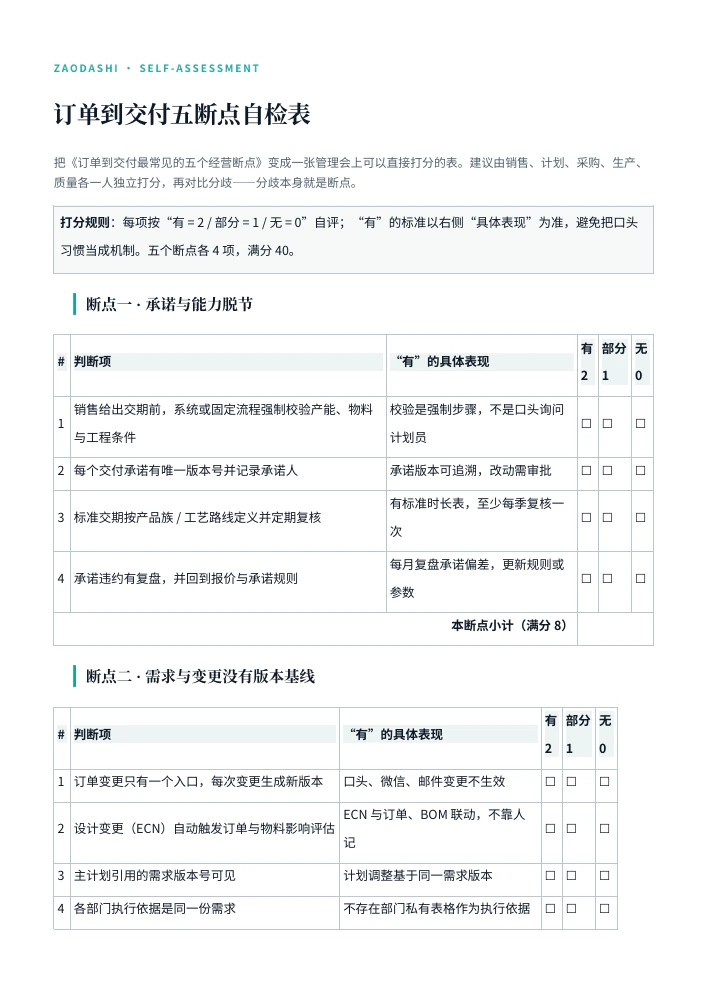
Lateness surfaces at the end of the chain, but its causes sit across five earlier steps: the promise, the change, material readiness, execution and exception closure. This checklist turns those five into 20 statements you can score in a single management meeting.
Version
- Version v1.0
- Updated 2026-09-01
- Language Chinese (PDF)
- Format PDF · printable
- Length Five breakpoints · 20 statements
Who it is for
The tool is written for the daily judgments of these roles.
It frames the judgment questions; the conclusion is yours to draw.
You need to explain the structural cause of lateness to the leadership team, rather than reporting that coordination is under way.
You want to confirm which step is actually failing before approving a system or a project.
You need to turn business complaints into explicit data, process and ownership requirements before discussing tools.
What it helps you judge
- Whether the delivery problem concentrates in the promise, the change, readiness, execution or exception closure.
- Whether each step has a shared definition, a named owner and a record you can check.
- Whether an improvement program or a broader diagnostic is the better first step right now.
- Give cross-functional discussion one shared score, so less time goes into arguing about blame.
What is inside
The structure of the document.
The list below sets out the chapter structure of the PDF and what each chapter covers, so you can decide before filling in the form.
- Breakpoint 1 · Promise and capabilityWhat a promised date is based on, whether capacity and material are checked, whether changes to the promise are recorded.
- Breakpoint 2 · Demand and versionHow a change travels, whether the plan has one version baseline, and who owns the sync.
- Breakpoint 3 · Readiness visibilityThe readiness definition, the critical material list, and when a gap becomes visible.
- Breakpoint 4 · Plan and shop floorHow long the gap between plan and actual stays invisible, and whether reporting data can be trusted.
- Breakpoint 5 · Exception closureWho owns an exception, the response commitment, escalation rules and the review mechanism.
- Reading your scoreWhat four score patterns imply: start a program, close data gaps, align definitions first, or run a diagnostic.
How to use it
Have sales, planning, purchasing, production and quality score separately, with no discussion first.
Focus on statements where functions gave different answers - that is usually a definition problem, not a data problem.
Take the lowest-scoring step with the largest impact as the first scope. Do not open all five at once.
Name a business owner and a review date, then score the same sheet again after 30 days.
What it will not tell you
The questions below fall outside this tool and need fuller data and interviews.
What it will not tell you
- It will not diagnose a specific late order - that needs record-level tracing per order.
- It will not produce an improvement percentage or an ROI; those only mean something after baseline analysis.
- It does not replace a system selection assessment and does not compare products.
- It will not assess inventory structure - use the other tool for that.
NEXT STEP
Bring the operating problem
you most want to change.
Delivery, inventory, operating visibility or a workflow where AI could help. Share your situation and priorities so we can identify a practical next step together.